Why Cleaning Your Data Center Is Not Optional !
Learn why data center cleaning is essential to prevent hardware failure and downtime. Discover industry standards and how to establish a proper maintenance schedule.
Key takeaways
- Dust and fine particulate matter accumulate silently on circuit boards and inside server chassis, causing hardware failures and unplanned downtime.
- Data centers require deep cleaning at least once per year and maintenance cleaning at least once per quarter.
- ASHRAE TC9.9 guidelines specify that data centers should maintain ISO 14644-1 Class 8 cleanliness levels as a baseline.
- Facilities should verify an expert cleaning team's qualifications through certificates, previous projects, and a proof of concept.
Why Cleaning Your Data Center Is Not Optional
Data center cleaning is not optional because dust inside the white space damages hardware slowly and without warning. ASHRAE's data center guidelines require rooms to be kept at ISO 14644-1 Class 8, and server makers design their equipment to run within that level.
Most organisations invest heavily in firewalls, security software and redundant systems to keep their data safe. Yet there is a threat inside the facility that no firewall can stop: dust and contamination.
While the security team watches for attackers, fine particles settle on circuit boards, clog cooling vents and build up inside server chassis. Unlike a cyberattack, this threat raises no alert. It builds up quietly until a hardware failure exposes it.
What does dust actually do to IT equipment?
The ASHRAE TC 9.9 contamination guidelines describe three kinds of damage:
- Mechanical: dust blocks cooling airflow, interferes with fans and moving parts, and causes abrasion.
- Chemical: dust that settles on circuit boards can corrode components, especially when humidity rises.
- Electrical: dust changes impedance and can bridge conductors.
The results are unplanned downtime, shorter hardware life, higher cooling costs and, in the worst cases, data loss. How each of these happens on a board is explained in why circuit boards fail inside data centers.
What does an outage cost?
Uptime Institute's Annual Outage Analysis 2024 found that 54% of operators said their most recent significant outage cost more than $100,000, and 16% said it cost more than $1 million.
Not every outage comes from dust. But a contaminated room raises the chance of failure every day it runs, and the cost of one failure easily exceeds years of cleaning.
How often should a data center be cleaned?
The question is not whether to clean, but how often. Two levels of cleaning are needed, and they do different jobs.
Deep cleaning: at least once a year
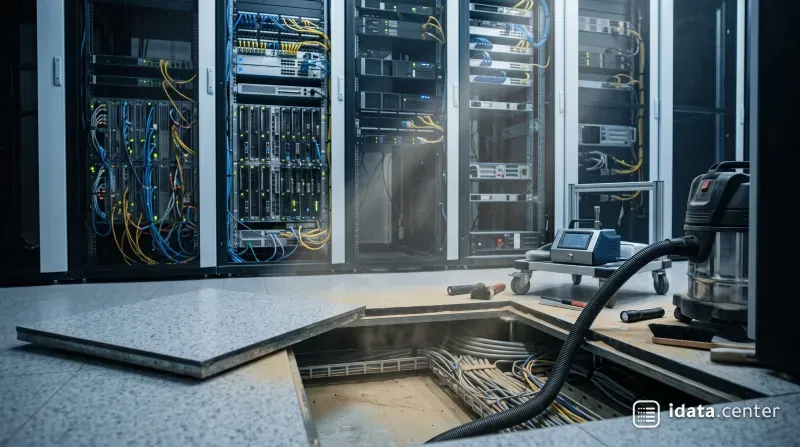
Deep cleaning covers every layer of the facility: above the false ceiling, the white space and the plenum under the raised floor. The hidden areas are where the heaviest contamination collects, out of sight and often forgotten.
Maintenance cleaning: once a quarter
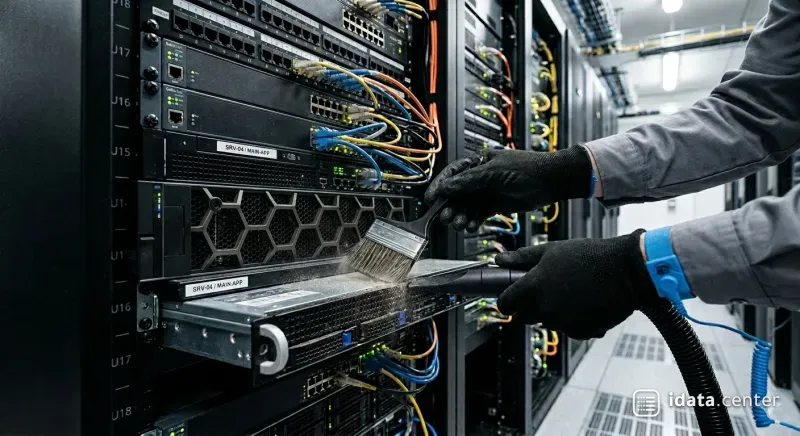
Maintenance cleaning covers the working space between the raised floor and the false ceiling, where the equipment lives and breathes. Done every quarter, it stops contamination from building up to the point where heavier work is needed.
Note: in my experience, yearly deep cleaning and quarterly maintenance cleaning are my field recommendations, not a standard. it would be according to the site conditions as first priority
What if there is no raised floor or false ceiling?
Many newer facilities sit on a concrete slab with an open ceiling. That does not reduce the need for a cleaning programme. It changes the scope: overhead cable trays, ducts and structure take the place of the plenum and ceiling void. Agree the exact scope with everyone involved before work starts, because an undefined scope leaves areas that nobody cleans. The scopes are defined in types of data center cleaning.
What is actually at risk?
Your data center holds financial records, customer data, operating systems and years of business information. Your organisation has invested a great deal in building that infrastructure and protecting it from outside threats.
The inside threat is less dramatic but just as damaging. A contaminated room does not announce itself. It lowers performance gradually, raises the chance of failure and shows up as a crisis at the worst moment.
So the useful question is not "Can we afford to clean regularly?" It is "Can we afford the downtime, the hardware replacement and the damage to our reputation if we don't?"
Which standard should your facility meet?
ASHRAE TC 9.9 states that data centers must be kept clean to ISO 14644-1 Class 8. This is not a goal to aim for one day. It is the baseline that server manufacturers expect, and running dirtier means running outside the conditions the equipment was designed for. Lenovo, for example, writes the same Class 8 requirement into its server documentation.
A structured cleaning programme is infrastructure maintenance, in the same category as UPS testing, cooling checks and fire suppression inspections.
How do you choose the right cleaning team?
Choosing the team comes before building the schedule. Many will claim experience, so ask them to show it:
- Training records and any certificates relevant to data center cleaning.
- A list of previous data center projects.
- A face-to-face meeting where they explain every step from start to handover, including the cleaning liquids, vacuums and tools they will use.
- For large or sensitive sites, a proof of ability on a small area before you award the full job.
Why a regular janitorial team is not enough is covered in can regular janitors clean inside a data center.
You prepare for the threats you can see. Apply the same discipline to the one you cannot.
Frequently asked questions
Why Cleaning Your Data Center Is Not Optional?
What does dust actually do to IT equipment?
What does an outage cost?
How often should a data center be cleaned?
What if there is no raised floor or false ceiling?
© Ashraf Almuhtaseb | idata.center. Short quotes are welcome with credit and a link to this article. Republishing the full article requires written permission.